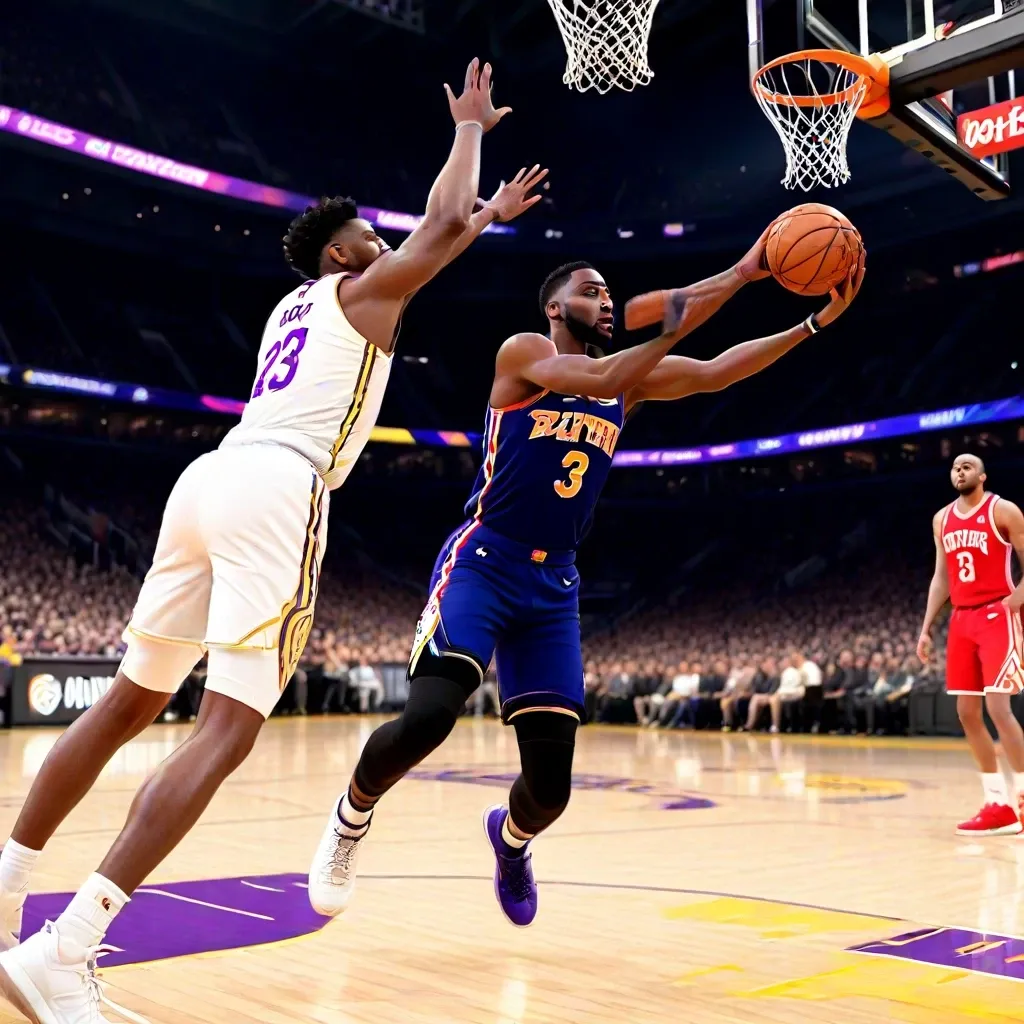
Remember that nail-biting game last season? The one everyone pegged as a guaranteed “over” because both teams were known for their breakneck speed? It ended up a snoozefest, UNDER by a mile! That’s NBA over/under betting in a nutshell – exhilarating, unpredictable, and ripe with opportunity if you know where to look.
The world of NBA totals seems simple on the surface: Will the combined score be over or under the oddsmakers’ line? But scratch a little deeper, and you’ll find a complex web of interwoven factors. Everyone talks about “pace,” assuming a high-pace game automatically equals a scoring bonanza. But that’s a dangerous oversimplification.
The truth is, consistently profitable over/under betting demands a more nuanced approach. It’s about understanding the subtle shifts in team strategies, the impact of defensive schemes, and the hidden variables that oddsmakers sometimes overlook. This guide is your key to unlocking that deeper understanding and transforming those head-scratching results into consistent winning bets. Let’s dive in and turn those underdogs into winners!
Pace: The Foundation (and the Fallacy)
In the fast-paced world of the NBA, the term “pace” gets thrown around frequently, especially when analyzing game dynamics and predicting outcomes. Pace, in NBA analytics, refers to the number of possessions a team has per 48 minutes. It’s a metric designed to quantify how quickly a team plays and how many opportunities they create to score. A high pace generally suggests a team favors an up-tempo style, emphasizing fast breaks and quick shots.
However, a common misconception is that a high pace automatically translates to high-scoring games and, therefore, consistent “over” results for bettors. This is a fallacy. While pace provides a foundational understanding of a team’s playing style, it’s far from the only factor determining the final score.
Numerous examples demonstrate this. Consider a game between two teams known for their high pace. One might assume a guaranteed shootout. However, if both teams also happen to be defensively stout, or if their shooting percentages are unusually low on that particular night, the game can easily fall under the predicted total. There are countless instances where teams ranked high in pace end up in low-scoring grinders. Focusing solely on possession numbers omits crucial elements like defensive efficiency, shot selection, and the ebb and flow of a specific game.
Relying solely on pace as a betting strategy is a flawed endeavor. It’s a piece of the puzzle, not the entire picture. Other NBA analytics and game-specific variables must be considered to make informed predictions.

Beyond the Box Score: Efficiency’s True Impact
Chasing high scores is about more than just how fast a team plays. You can have all the speed in the world, but if you’re constantly turning the ball over or missing shots, you’re not going to light up the scoreboard. That’s where offensive efficiency comes in. It’s the secret sauce that separates the truly explosive offenses from those that just run around a lot.
We’re talking about metrics like points per possession – how many points a team scores for each opportunity they have with the ball. Or true shooting percentage, which factors in all types of shots – twos, threes, and free throws – to give you a more accurate picture of a team’s overall shooting ability. Another key indicator is offensive rating, which estimates how many points a team scores per 100 possessions.
Think of it this way: a team could play at a breakneck pace, getting tons of possessions, but if they’re only scoring, say, 0.9 points per possession, they’re not going to score a ton of points. You might see a team like that and think “high-scoring game incoming!” but the reality might be very different. On the flip side, a team that plays at a more deliberate pace but scores 1.2 points per possession is going to rack up the points even with fewer opportunities. Focusing on efficiency is the key to understanding if a team is actually able to translate it’s high pace in scoring.
Personally, I’ve been burned by overlooking efficiency in the past. I remember one game where I saw two teams with high adjusted tempo, and I immediately jumped on the over. What I didn’t realize was that one of those teams was incredibly inefficient on offense. They ended up bricking open looks and turning the ball over way too often, and the game ended up going way under. That experience taught me a valuable lesson like true shooting percentage: pace is only half the battle. To truly predict high-scoring outcomes, you need to understand offensive efficiency and its impact.
Defensive Disruptors: How Opposing Styles Affect Pace
The clash of styles in basketball extends beyond offensive philosophies; it’s significantly shaped by defensive approaches. A team’s defensive identity can directly influence the game’s tempo, often disrupting the opponent’s intended pace and, consequently, the final score. Understanding these defensive dynamics is crucial for accurately predicting game outcomes.
One of the most significant factors in pace control is transition defense. A team that excels at getting back and setting up its defense after a missed shot or turnover can effectively stifle a fast-paced offensive team, forcing them into a half-court setting where scoring opportunities become more limited. Teams prioritizing transition defense aim to eliminate easy baskets and control the flow, dictating a more methodical game.
Half-court defense is equally crucial. Different schemes, such as trapping zones or aggressive switching defenses, can disrupt offensive rhythm. For instance, a team employing a trapping defense might look to create turnovers and quick scores, ironically speeding up the game despite its defensive nature. Conversely, a team focused on limiting penetration and forcing contested jump shots will likely slow the pace. Switching defenses, while versatile, can also lead to mismatches that either create scoring opportunities or bog down the offense, depending on the players involved.
Evaluating defensive matchups is paramount. A team with strong perimeter defenders can limit a high-scoring guard, forcing the offense to rely on other options. Similarly, a team with dominant interior defenders can deter drives to the basket, slowing down the offensive attack. Observing these matchups and understanding how each team’s defensive strengths and weaknesses align is how I was able to predict outcomes for specific games, such as predicting the under in a game between a high-scoring team matched against a team with an excellent defensive record.

Game Context Matters: Tempo Regulation
While offensive and defensive strategies are crucial for dictating tempo, a less obvious, yet equally important factor, is the game context. This encompasses elements like the current game state, the score differential, and the underlying team motivation, all of which can significantly influence the pace of play.
The score often acts as a primary driver of tempo regulation. Teams leading by a comfortable margin might consciously choose to slow down the game, prioritizing ball control and efficient possessions. This strategy aims to shorten the game and minimize opportunities for their opponents to mount a comeback. Conversely, teams facing a significant deficit often try to increase the game’s pace, attempting quick scores and aggressive plays to close the gap rapidly. A large score differential, often seen in blowouts, almost always leads to a decrease in overall pace as the leading team focuses on running down the clock, while the trailing team may lose motivation, further impacting their defensive intensity and offensive urgency. For example, a team up by 20 points in the fourth quarter is highly unlikely to maintain the same fast-break tempo they had in the first.
Late-game situations introduce another layer of complexity. Fouling strategies, employed by trailing teams to extend the game and gain possession, can artificially inflate the total score, even if the overall pace remains relatively slow. Furthermore, a team’s motivation profoundly affects their effort and intensity on both ends of the court. A team vying for a playoff spot will likely exhibit greater urgency and play at a faster tempo than a team already eliminated from contention. Therefore, understanding these contextual elements is crucial for a comprehensive analysis of tempo regulation in any basketball game.
Spotting Value: Identifying Over/Under Opportunities
Unlocking consistent profitability in over/under betting, particularly in fast-paced games, demands a keen eye for value. It’s about moving beyond simply predicting whether the final score will be higher or lower than the posted total. It requires a strategic approach to identify when the odds offered by bookmakers don’t accurately reflecting the likely outcome. A step-by-step approach will help you in this process of thinking while betting.
First, the understanding of line movement is crucial. Significant shifts in the over/under line often signal new information entering the market, whether it’s sharp money coming in, a weather forecast change, or breaking news. Monitoring these movements and trying to understand the reasons can provide early insights into potential value. Did the line move drastically after an injury report surfaced? This could signify that the market is undervaluing the impact of the injured player, potentially creating an edge on the opposite side of the bet.
Injury reports are very important and more so than ever. A star point guard sidelined for an NBA game will dramatically impact a team’s offensive efficiency and pace. Understanding how injuries affect both scoring output and defensive capabilities is paramount. Similarly, situational awareness is an often-overlooked element. Teams playing on the second night of a back-to-back, especially with travel involved, are often fatigued. This can impact their ability to sustain a high pace throughout the game, potentially leading to the under being the favorable bet. Conversely, a team coming off several days of rest might be primed for a high-scoring performance.
Expert analysis can also be a tool in your betting toolbox. Studying the analysis, insights, and predictions of seasoned analysts is a smart way to do your research. These experts have a wealth of information and can give you an edge in your betting strategy that you otherwise would not have found.
Value betting isn’t about guaranteed wins; it’s about consistently placing bets where the probability of winning exceeds the implied probability reflected in the odds. For example, I once identified a significant edge in a college basketball game by recognizing that the market was overvaluing a team’s offensive capabilities due to recent high-scoring performances. However, closer examination revealed that those performances came against weaker defensive teams. In their upcoming game against a team with a stifling defense, I predicted a lower score. Despite the over being heavily favored, I placed a substantial bet on the under, and the game finished well below the projected total.
Analyzing Team Trends
Digging into team-specific trends is essential for smart over/under betting. Start by examining a team’s over/under record across their recent games. Look for patterns. Are they consistently hitting the over at home but the under on the road? Further, look into historical matchups between the two teams. Has their prior meeting typically resulted in high-scoring affairs, or have defensive battles been the norm? Dissecting data by home and away splits can reveal meaningful differences in a team’s scoring tendencies. For instance, suppose a team averages 110 points per game at home and allows 100, but on the road, they average 95 and allow 105. This indicates a significant difference in pace and scoring potential depending on the game’s location.
Monitoring Key Player Matchups
Individual player matchups are sometimes overlooked but have a significant impact on the final score, especially on high-pace teams. A stellar point guard can impact the game heavily. Look into mismatches and use them to your advantage in your game. For example, if a team’s primary scorer is consistently guarded by an elite defender, their offensive output might be suppressed, pushing the game towards the under. Conversely, a mismatch in the post, where a smaller defender is tasked with guarding a dominant center, could lead to increased scoring opportunities and potentially favor the over. Also, understanding how defensive schemes will impact player performance, and therefore game outcome, is also essential.
Conclusion: Making Informed Bets
Navigating the world of NBA betting, particularly when considering over/under strategies, can feel like a high-stakes game. However, understanding that a team’s pace is just one piece of the puzzle is crucial. We’ve explored how defensive efficiency, offensive firepower, and even the intangible factors like player matchups and rest, significantly influence game totals.
The key takeaway? Ditch the simple pace-equals-points equation. It’s time to embrace a more holistic approach. By incorporating the insights discussed – analyzing defensive metrics, assessing offensive capabilities, scrutinizing team news, and understanding the nuances of over/under lines – you’ll be equipped to make far more informed decisions.
So, step onto the court armed with knowledge. Evaluate beyond surface-level stats, consider all angles, and translate that analysis into strategically placed wagers. Success in NBA betting isn’t about luck; it’s about informed decision-making. The path to winning bets is paved with expert advice and a willingness to dig deeper. Apply these strategies, trust your judgment, and remember, with the right approach, those winning bets are within reach.